 |
Self-portrait as the Allegory of Painting,
Artemisia Gentileschi, 1630s |
Artemisia Gentileschi was the first woman to be allowed entry into Florence's Accademia delle Arti del Disegno. A Baroque painter who worked in the style of Caravaggio, she was trained mainly by her father. Many art historians believe she was raped by a teacher as a teenager. They believe that this experience is the reason she returned to the story of Judith and Holofernes time and again in her paintings.
 |
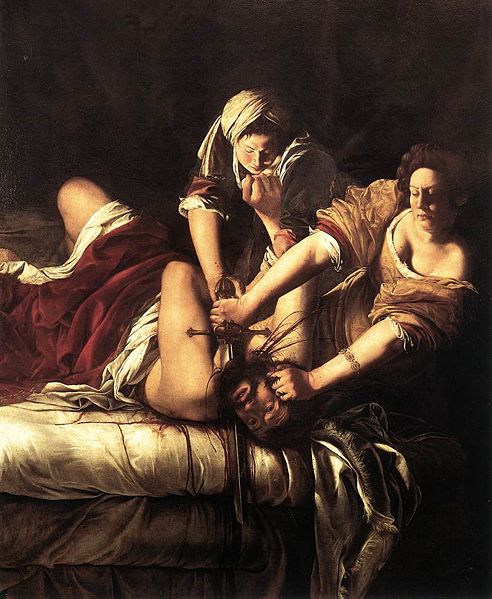
Judith Slaying Holofernes,
Artemisia Gentileschi, 1614-1620 |
Regardless of the initial inspiration, or maybe because of it, her depictions of Judith and Holofernes are her strongest works. As Gentileschi continues to develop her own artistic style, her works become uniquely her own and more gruesome in her treatment of Holofernes. Take for example her
Judith Slaying Holofernes in the Uffizi (right). There is blood streaming down Holofernes' neck on to the starkly white bed sheets. Gentileschi has taken Caravaggio's already highly dramatic composition and heightened it, especially with the re-positioning of Judith and Holofernes as well as the look of determination on her face and his struggle to break free.
 |
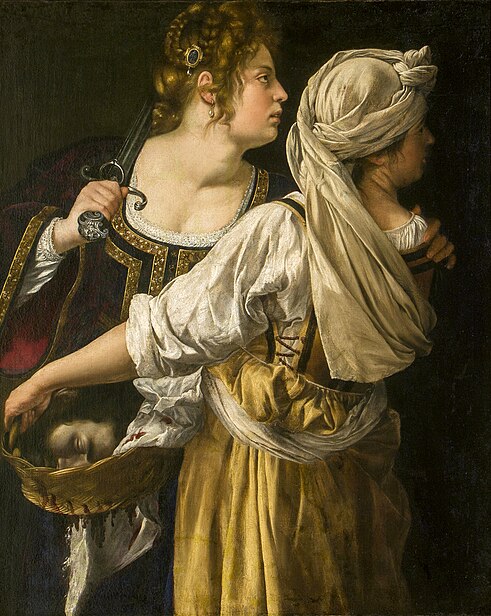
Judith and her Maidservant,
Artemisia Gentileschi, 1613 - 1614 |
Around the same time, she focuses on the aftermath of the beheading. In
Judith and her Maidservant (left)
, Gentileschi depicts the two women as they try to smuggle Holofernes' head out of the camp. They look fearfully out of the frame, suggesting they are on the verge of being caught. These dramatic depictions of Judith and Holofernes are what put Gentileschi on the art historical map.

No comments:
Post a Comment