Sunday, December 2, 2012

The Mechanics of Dome Building (Week 6, Blog 1)

View of the Florence Duomo towering over Florence.
Photograph by Annie Bigelow

Leone Battista Alberti wrote of Filippo Brunelleschi in his dedication of On Painting saying, “What man however hard of heart or jealous, would not praise Filippo the architect when he sees here such an enormous construction towering above the skies, vast enough to cover the entire Tuscan population with its shadow, and done without the aids of beams or elaborate wooden supports? Surely a feat of engineering, if I am not mistaken, that people did not believe possible these days and was probably equally unknown and unimaginable among the ancients.”

Taccola’s caption read: “It is built for four reasons.
First, because it turns rapidly. Second, because it
facilitates lifting as large weights are raise on high.
Third, because it runs forward and not backward.
Fourth, it does not waste time”

I was intrigued when I read this by the mechanics of exactly how the Dome was built, especially “without the aids of beams or elaborate wooden supports”. So I did some digging. Brunelleschi couldn't build centered scaffolding like one normally would, as there wasn't enough wood available to build scaffolding for the 42 meter diameter dome.

Not having a centralized scaffolding system raised many problems, including the problem of getting thousands of tons of materials up to the top of the Dome. As a solution, he designed and built a new hoist mechanism. While Brunelleschi kept notebooks with his engineering ideas, they no longer exist – meaning there are no original illustrations or designs for his hoist mechanism. Luckily one of his contemporaries and confidant, Mariano di Jacopo, known as Taccola, did document Brunelleschi’s ideas. Taccola published two works called, On Engines and On Machines. In them are illustrations of Brunelleschi’s machines that he used to build the Dome. One illustration (shown left) depicts the new hoisting mechanism the Brunelleschi developed. It features a series of wheels and counterweights and was horse powered, quiet literally. 

Bibliographical note: Toby Lester's Da Vinci's Ghost specifically Chapter 5 "The Artist-Engineer" was used as reference for information on Brunelleschi's hoist mechanism. 

Alberti - Writer or Artist? (Week 6, Blog 2)


Of Alberti, Vasari writes, "the famous Leon Battista Alberti is better known for his writings than for the works he did with his hands" and Alberti did do quite a bit of writing. By Vasari's account here is a list of the works he published: "he composed a treatise on architecture in ten books which he published in 1481... a treatise on painting in three books... a treatise on pulling weights and the rules for measuring heights, as well as a book on the civic life and some erotic works in both prose and verse." With a list of published works that long, one can hardly be surprised that his written work has surpassed the fame of his physical work. But that shouldn't diminish the importance of those physical works.
The facade of Santa Maria Novella


The true talent of Alberti as an architect was his ability to see and replicate design elements of Ancient Roman architecture and adjust them to fit the needs of Renaissance Italy. Take for example, the facade of Santa Maria Novella in Florence. He took many aspects of traditional Roman architecture, arches, the frieze, columns and replicated their shape to create a uniquely timeless facade for the church.

But ultimately his thoughts on the theory of architecture out way the works he did in the actual practice of architecture.

The Fountain of the Four Rivers (Blog Week 12)

Bernini's Fountain of the Four Rivers
in the Piazza Navona
Photo courtesy of: Yortw
 on Flickr Creative Commons 

My father has been known to say, "If it's a Baroque sculpture in Rome, it's a Bernini." For better or worse my father is rarely wrong. One of the best known and most commonly photographed of his works is located in Piazza Navona and happens to be his favorite, The Fountain of the Four Rivers. Pope Innocent X commissioned the work for the piazza outside his family palazzo and Sant' Agnese in Agone. The top of the fountain features an Egyptian obelisk that had sat gathering dust for years after being plucked out of Egypt as part of a Roman artifact collection project. The inclusion of this obelisk as well as the cross perched atop it are both references to Christianity superseding the Pagan religions.

Detail of the Fountain of the Four Rivers
Photo courtesy of: MAMJDOH
on Flickr Creative Commons
The four river depicted in the fountain are the Nile, Danube, Ganges, and Platte - representing the four continents (Africa, Europe, Asia and the Americas) that have been influenced by the Church. Each of the four sides of the fountain represent one of the four rivers in the form of an allegorical figure with symbols associated with each river.

To my eye, a huge part of the aesthetic success of the work can be attributed to the way Bernini treats the marble. Rather than smoothing everything to perfection he leaves much of his surface rough and rugged making the allegorical rivers appear to be perched into their setting. The viewer can easily envision the rivers breathing and moving giving them a truly organic feel.

Artemisia Gentileschi's Depictions of Judith (Week 13 Blog)

File:Self-portrait as the Allegory of Painting by Artemisia Gentileschi.jpg
Self-portrait as the Allegory of Painting, 
Artemisia Gentileschi, 1630s 
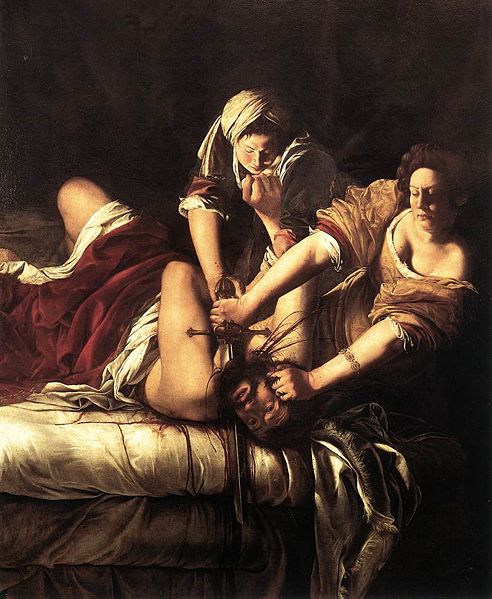
Artemisia Gentileschi was the first woman to be allowed entry into Florence's Accademia delle Arti del Disegno. A Baroque painter who worked in the style of Caravaggio, she was trained mainly by her father. Many art historians believe she was raped by a teacher as a teenager. They believe that this experience is the reason she returned to the story of Judith and Holofernes time and again in her paintings.

File:GENTILESCHI Judith.jpg
Judith Slaying Holofernes,
Artemisia Gentileschi, 1614-1620
Regardless of the initial inspiration, or maybe because of it, her depictions of Judith and Holofernes are her strongest works. As Gentileschi continues to develop her own artistic style, her works become uniquely her own and more gruesome in her treatment of Holofernes. Take for example her Judith Slaying Holofernes in the Uffizi (right). There is blood streaming down Holofernes' neck on to the starkly white bed sheets. Gentileschi has taken Caravaggio's already highly dramatic composition and heightened it, especially with the re-positioning of Judith and Holofernes as well as the look of determination on her face and his struggle to break free.

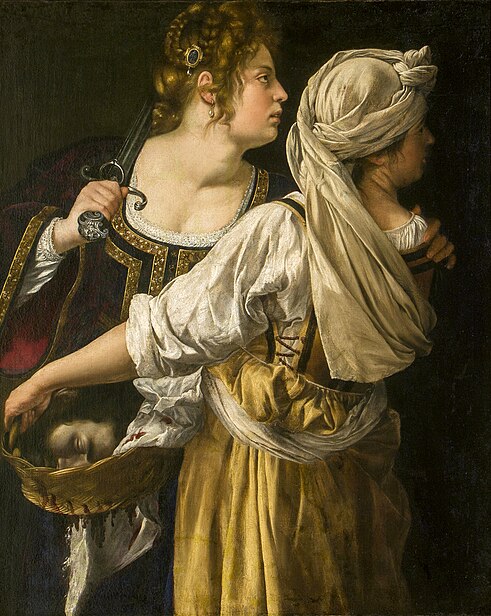
File:Gentileschi judith1.jpg
Judith and her Maidservant, 
Artemisia Gentileschi, 1613 - 1614
Around the same time, she focuses on the aftermath of the beheading. In Judith and her Maidservant (left), Gentileschi depicts the two women as they try to smuggle  Holofernes' head out of the camp. They look fearfully out of the frame, suggesting they are on the verge of being caught. These dramatic depictions of Judith and Holofernes are what put Gentileschi on the art historical map.