Sunday, December 2, 2012

The Mechanics of Dome Building (Week 6, Blog 1)

View of the Florence Duomo towering over Florence.
Photograph by Annie Bigelow

Leone Battista Alberti wrote of Filippo Brunelleschi in his dedication of On Painting saying, “What man however hard of heart or jealous, would not praise Filippo the architect when he sees here such an enormous construction towering above the skies, vast enough to cover the entire Tuscan population with its shadow, and done without the aids of beams or elaborate wooden supports? Surely a feat of engineering, if I am not mistaken, that people did not believe possible these days and was probably equally unknown and unimaginable among the ancients.”

Taccola’s caption read: “It is built for four reasons.
First, because it turns rapidly. Second, because it
facilitates lifting as large weights are raise on high.
Third, because it runs forward and not backward.
Fourth, it does not waste time”

I was intrigued when I read this by the mechanics of exactly how the Dome was built, especially “without the aids of beams or elaborate wooden supports”. So I did some digging. Brunelleschi couldn't build centered scaffolding like one normally would, as there wasn't enough wood available to build scaffolding for the 42 meter diameter dome.

Not having a centralized scaffolding system raised many problems, including the problem of getting thousands of tons of materials up to the top of the Dome. As a solution, he designed and built a new hoist mechanism. While Brunelleschi kept notebooks with his engineering ideas, they no longer exist – meaning there are no original illustrations or designs for his hoist mechanism. Luckily one of his contemporaries and confidant, Mariano di Jacopo, known as Taccola, did document Brunelleschi’s ideas. Taccola published two works called, On Engines and On Machines. In them are illustrations of Brunelleschi’s machines that he used to build the Dome. One illustration (shown left) depicts the new hoisting mechanism the Brunelleschi developed. It features a series of wheels and counterweights and was horse powered, quiet literally. 

Bibliographical note: Toby Lester's Da Vinci's Ghost specifically Chapter 5 "The Artist-Engineer" was used as reference for information on Brunelleschi's hoist mechanism. 

Alberti - Writer or Artist? (Week 6, Blog 2)


Of Alberti, Vasari writes, "the famous Leon Battista Alberti is better known for his writings than for the works he did with his hands" and Alberti did do quite a bit of writing. By Vasari's account here is a list of the works he published: "he composed a treatise on architecture in ten books which he published in 1481... a treatise on painting in three books... a treatise on pulling weights and the rules for measuring heights, as well as a book on the civic life and some erotic works in both prose and verse." With a list of published works that long, one can hardly be surprised that his written work has surpassed the fame of his physical work. But that shouldn't diminish the importance of those physical works.
The facade of Santa Maria Novella


The true talent of Alberti as an architect was his ability to see and replicate design elements of Ancient Roman architecture and adjust them to fit the needs of Renaissance Italy. Take for example, the facade of Santa Maria Novella in Florence. He took many aspects of traditional Roman architecture, arches, the frieze, columns and replicated their shape to create a uniquely timeless facade for the church.

But ultimately his thoughts on the theory of architecture out way the works he did in the actual practice of architecture.

The Fountain of the Four Rivers (Blog Week 12)

Bernini's Fountain of the Four Rivers
in the Piazza Navona
Photo courtesy of: Yortw
 on Flickr Creative Commons 

My father has been known to say, "If it's a Baroque sculpture in Rome, it's a Bernini." For better or worse my father is rarely wrong. One of the best known and most commonly photographed of his works is located in Piazza Navona and happens to be his favorite, The Fountain of the Four Rivers. Pope Innocent X commissioned the work for the piazza outside his family palazzo and Sant' Agnese in Agone. The top of the fountain features an Egyptian obelisk that had sat gathering dust for years after being plucked out of Egypt as part of a Roman artifact collection project. The inclusion of this obelisk as well as the cross perched atop it are both references to Christianity superseding the Pagan religions.

Detail of the Fountain of the Four Rivers
Photo courtesy of: MAMJDOH
on Flickr Creative Commons
The four river depicted in the fountain are the Nile, Danube, Ganges, and Platte - representing the four continents (Africa, Europe, Asia and the Americas) that have been influenced by the Church. Each of the four sides of the fountain represent one of the four rivers in the form of an allegorical figure with symbols associated with each river.

To my eye, a huge part of the aesthetic success of the work can be attributed to the way Bernini treats the marble. Rather than smoothing everything to perfection he leaves much of his surface rough and rugged making the allegorical rivers appear to be perched into their setting. The viewer can easily envision the rivers breathing and moving giving them a truly organic feel.

Artemisia Gentileschi's Depictions of Judith (Week 13 Blog)

File:Self-portrait as the Allegory of Painting by Artemisia Gentileschi.jpg
Self-portrait as the Allegory of Painting, 
Artemisia Gentileschi, 1630s 
Artemisia Gentileschi was the first woman to be allowed entry into Florence's Accademia delle Arti del Disegno. A Baroque painter who worked in the style of Caravaggio, she was trained mainly by her father. Many art historians believe she was raped by a teacher as a teenager. They believe that this experience is the reason she returned to the story of Judith and Holofernes time and again in her paintings.

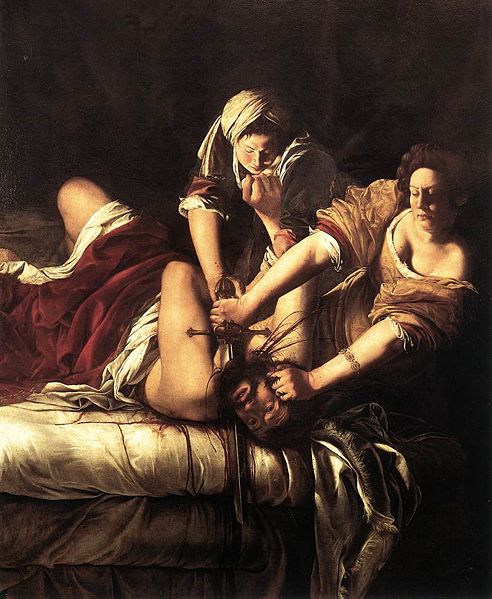
File:GENTILESCHI Judith.jpg
Judith Slaying Holofernes,
Artemisia Gentileschi, 1614-1620
Regardless of the initial inspiration, or maybe because of it, her depictions of Judith and Holofernes are her strongest works. As Gentileschi continues to develop her own artistic style, her works become uniquely her own and more gruesome in her treatment of Holofernes. Take for example her Judith Slaying Holofernes in the Uffizi (right). There is blood streaming down Holofernes' neck on to the starkly white bed sheets. Gentileschi has taken Caravaggio's already highly dramatic composition and heightened it, especially with the re-positioning of Judith and Holofernes as well as the look of determination on her face and his struggle to break free.

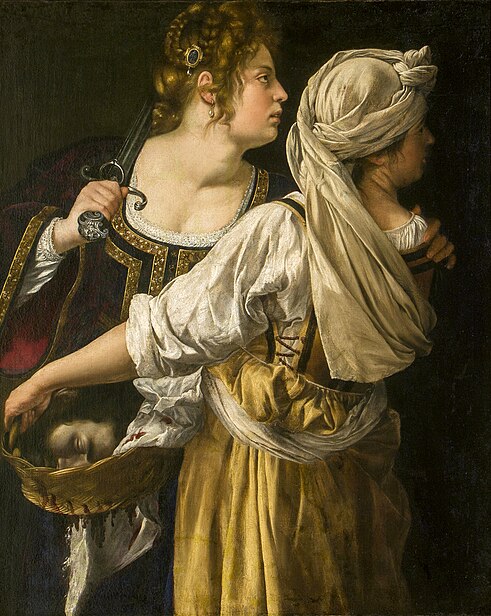
File:Gentileschi judith1.jpg
Judith and her Maidservant, 
Artemisia Gentileschi, 1613 - 1614
Around the same time, she focuses on the aftermath of the beheading. In Judith and her Maidservant (left), Gentileschi depicts the two women as they try to smuggle  Holofernes' head out of the camp. They look fearfully out of the frame, suggesting they are on the verge of being caught. These dramatic depictions of Judith and Holofernes are what put Gentileschi on the art historical map.

Sunday, September 30, 2012

Donatello: Creator of Works of Grace and Excellence

Donatello's St. John the Baptist in
the Duomo of Siena.
Photo by Annie Bigelow
Detail of the head and left hand of
St. John the Baptist. Please note the parted
lips and fingers raised in greeting.
Photo by Annie Bigelow
In his Life of Donatello, Florentine Sculptor Giorgio Vasari praises his many works claiming they "possess so much grace and excellence and such a fine sense of design that they were considered to be more like the distinguished works of the ancient Greeks and Romans than those of any other artist that ever existed". In comparing his works to those of other sculptors of his time, specifically the proto-Renaissance sculptors that proceeded him, Vasari's claim has merit. His rendering of the body suggests careful observation of human anatomy and movement; his drapery mimics natural folding against the body and suggests the limbs beneath; and most strikingly in the case of his bronze St. John the Baptist in the Siena Duomo, his rendering of facial features and emotion is almost eerily close to life.

Detail of the right hand of St. John the Baptist. Please note the lighter band of bronze just above
the wrist as well as the awkward clenching of the fingers.
Photo by Annie Bigelow

Donatello's John the Baptist depicts an old, weathered man, pained from the life of sacrifice. His mouth is formed in such a way that he seems tone uttering a tired sigh as he acknowledges the viewer with two raised fingers. Vasari's only mention of this breathtaking (pun intended) is as a "Saint John the Baptist in metal, which lacked its right arm below the elbow; and this, it is said, Donatello left unfinished because he had not been satisfied with the full payment." We know that Vasari was at least partially incorrect as more of Donatello's works were and are in Siena. But moreover, John the Baptist is in possession of both of his arms. It could be that Donatello did come back and finish the work or completed it originally, but perhaps the Cathedral had the work finished by another. Upon closer examination, the right hand seems to be the most awkwardly rendered part of the work and there is a line of welding suggesting that the arm was added later.

Bibliographic Notes: Quotes from Vasari can be found in the Oxford World Classics Edition of Giorgio Vasari's Lives of the Artists. 

Ambroggio Lorenzetti's Polyptych

Ambrogio Lorenzetti, a proto-Renaissance Sienese painter, is arguably best known for his Allegories of Good and Bad Government in the Palazzo Pubblico in Siena. While I didn't get the chance to see those works while visiting Siena on Friday, I did have the opportunity to see one of his earlier works, Saints Catherine of Alexandria, Benedict, Francis of Assisi, and Mary Magdalene in the Museo dell'Opera.

This work dating from 1320 - 1330 is four parts of a polyptych. A central panel seems to be missing as all four main figures and the four secondary figures in the trefoil frames face toward the middle. The polyptych is believed to be part of the Altar of the Magi that used to be in the Siena Duomo. Perhaps the polyptych is in sections now with the central panel missing because, like Duccio's Maesta, it was broken up to be sold.

The work can firmly be placed in the proto-Renaissance with the evident influence of the International Gothic Style and the influence of Humanism. The Gothic style is reflected in the pointed arches and gabled shape of each section. Humanistic ideas are reflected in the individualized treatment of the saints. Ambrogio Lorenzetti hasn't yet reached the level of realism prevalent in the Renaissance as his figures are still stiff, especially Benedict, and the drapery is too uniform in Francis and doesn't suggest or reflect the body beneath. Nonetheless, the work exhibits a beautiful and very Sienese use of color.

Sunday, September 23, 2012

Giotto - Dimmer of Cimabue's Light


18th Century Sculpture of Giotto
Photo courtesy of McPig on Flickr Creative Commons
In Pergatorio, Dante stated, “Once Cimabue thought to hold the field/ As painter; Giotto now is all the rage,/ Dimming the lustre of the others fame.” Vasari clearly felt the same, as he states in his Lives of the Artist that “Giotto truly eclipsed Cimabue’s fame just as a great light eclipses a much smaller one”. Art historians have carried on this belief for centuries as Gardner’s Art through the Ages calls Giotto the first Renaissance painter and refers to him as, “A pioneer in pursuing a naturalistic approach to representation based on observation, he made a much more radical break with the past”. 

Just one glimpse of a fresco from the Arena Chapel and it’s easy to see why Giotto has dimmed the fame of Cimabue as well as why he is considered the father of Renaissance painting. There are also examples of his groundbreaking style in his works that can be found right here in Florence.

One of such examples is Giotto’s Badia Polyptych. Originally designed for the Badia church, the work is now housed in the Uffizi gallery. This work is a series of connected wooden panels depicting Mary in the center with baby Jesus and various saints on either side, including John the Evangelist and Peter. While still focusing on the Virgin Mary and using the golden background utilized by medieval artists and his supposed teacher, Cimabue, Giotto has given each of his figures even more humanized, worldly features. A work like this clearly establishes Giotto as the connecting thread between the Medieval and Renaissance periods of art.     

Bibliographical Notes: The Dante and Vasari quotes can be found on page 13 of the Oxford World’s Classics edition of Giorgio Vasari’s The Lives of the Artists. The quote from Gardner’s Art Through the Ages can be found on page 407 of the 14th backpack edition, Renaissance and Baroque